Why AI-Generated Content Still Needs Human Oversight
Artificial intelligence has made it easier than ever to create written content, summarize information, generate images, analyze documents, and complete a variety of other tasks. For businesses, these capabilities can save employees significant amounts of time and make certain workflows much more efficient.
But speed doesn’t necessarily equal accuracy.
AI systems can produce convincing answers that contain incorrect information, misunderstand context, or present assumptions as facts. Because the resulting content can often sound confident and professional, mistakes may not be immediately obvious.
This creates an important distinction for businesses: AI can assist with work, but it should not automatically be treated as the final authority.
Human oversight remains an important part of using AI responsibly.
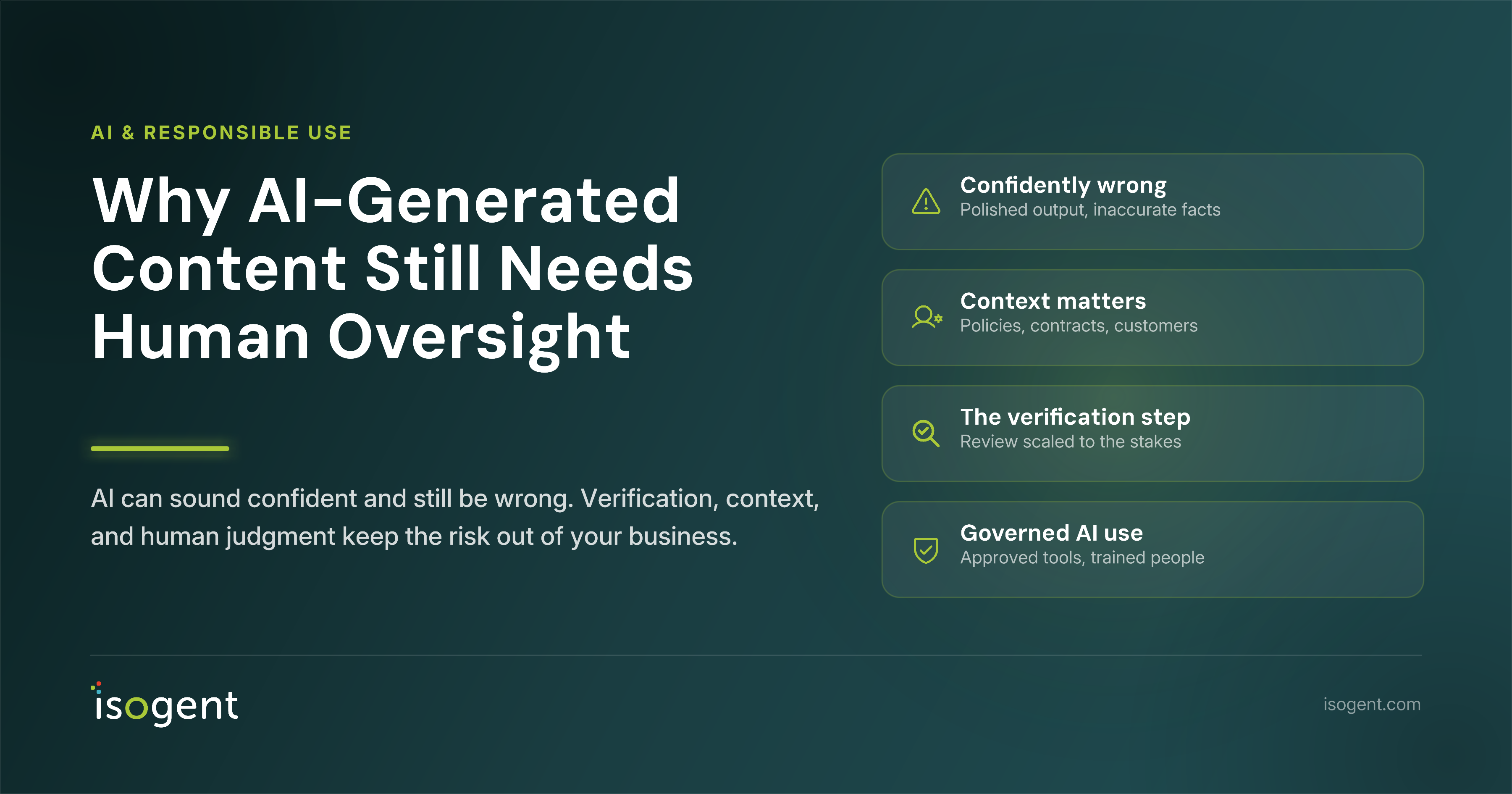
AI Can Be Confidently Wrong
One of the biggest challenges with generative AI is that it doesn’t always know when it is wrong.
An AI system may generate an inaccurate statistic, misinterpret a question, cite information incorrectly, or create a plausible explanation that isn’t supported by reliable evidence. The response can still appear polished enough that someone might accept it without questioning the result.
This is particularly concerning when AI-generated information is used for business decisions.
A marketing team may use AI to create customer-facing material. An employee may use it to summarize an important document. A salesperson may ask AI to research a potential client. An analyst may use AI to help interpret data.
In each case, an error could make its way into a business process before anyone notices.
Context Matters
AI tools also don’t automatically understand every organization’s unique circumstances.
A recommendation that makes sense in one situation may be inappropriate in another. Company policies, contractual obligations, customer expectations, industry requirements, and internal processes can all change the appropriate answer.
Human employees understand these contextual factors in ways that an AI system may not.
This is why AI-generated work should generally be treated as a starting point rather than an unquestionable final product.
The Verification Step
One of the simplest ways organizations can improve AI usage is by establishing a verification process.
Before important AI-generated information is used, employees can ask:
- Is the information accurate?
- Can important claims be verified?
- Does the output match the original request?
- Does it contain sensitive or inappropriate information?
- Does it follow company policies?
- Would a customer or business partner reasonably expect this information to be reviewed?
The level of review should depend on the consequences of being wrong.
A brainstorming exercise may require little oversight. A customer-facing document, financial analysis, security recommendation, or legal-related material deserves considerably more scrutiny.
AI Should Augment Employees, Not Replace Judgment
The strongest use of AI often isn’t asking it to completely replace a task. Instead, employees can use AI to accelerate portions of their existing workflow.
AI can generate a first draft. An employee can refine it.
AI can summarize a document. An employee can verify the important points.
AI can suggest possible solutions. An employee can determine which solution actually makes sense.
This approach preserves the efficiency benefits of AI while maintaining human accountability.
Creating Responsible AI Workflows
Organizations can formalize this approach by creating guidelines around AI usage.
These might include defining which tasks are appropriate for AI, identifying information that should never be entered into public AI systems, establishing review requirements for customer-facing content, and specifying which AI platforms are approved for business use.
Training is equally important. Employees don’t necessarily need to become AI experts, but they should understand the limitations of the tools they are using.
A simple policy that says “verify important information before using it” can prevent many problems, especially when combined with practical training.
How Isogent Can Help
Isogent can help organizations establish the technical and administrative controls surrounding AI usage.
Isogent can assist with approved application lists, identity and access management, data protection policies, security controls, and employee training. They can also help organizations evaluate AI platforms before they become widely adopted across the business.
This is particularly valuable as AI becomes embedded into existing business applications. Organizations may eventually have AI capabilities built into their productivity suites, security platforms, CRM systems, and other applications.
Managing AI responsibly will therefore become less about controlling one specific tool and more about establishing consistent practices across the entire technology environment.
Summary
AI can dramatically improve productivity, but its ability to generate convincing information doesn’t guarantee that the information is correct. Errors, missing context, and inaccurate assumptions can create problems when AI-generated content is accepted without review. Businesses can reduce these risks by establishing verification processes, training employees, defining appropriate AI use cases, and maintaining human oversight over important decisions and communications. Isogent can support these efforts by helping organizations establish secure AI environments, appropriate policies, and consistent technology governance.
Sources:
https://www.microsoft.com/ai/responsible-ai
https://www.nist.gov/itl/ai-risk-management-framework
Redefining the Standard of Human Oversight for AI Negligence – Harvard Journal of Law & Technology
Assuring trust in an AI-driven world | EY – US
